
When Power Lies
Donald Trump and the Politics of Exhaustion

“The ideal subject of totalitarian rule is not the convinced Nazi or the convinced Communist, but people for whom the distinction between fact and fiction, true and false, no longer exists.”
Hannah Arendt, The Origins of Totalitarianism (1951)
Introduction
“The Choice”
The essay argues that contemporary politics, shaped by decades of neoliberal dispossession and accelerated by figures like Donald Trump, is moving steadily toward that condition, not through mass belief, but through fatigue, confusion, and withdrawal.
Hannah Arendt was not referring to ideological fanaticism or widespread indoctrination. Instead, she described a political state in which truth no longer constrains power, reality no longer grounds public life, and contradictions have no repercussions. In this landscape, belief becomes unnecessary. Persuasion becomes optional. What remains is endurance and compliance.
This condition does not arise accidentally. Steve Bannon described the governing strategy of the Donald Trump era as a need to “flood the zone with shit.” The phrase was crude, but the logic was precise. The aim was not to persuade the public of a single falsehood, but to overwhelm the informational environment so completely that truth itself lost traction.
Under this strategy, volume replaces credibility. Claims do not need to be consistent, accurate, or even plausible because they are not designed to withstand scrutiny. Each new assertion displaces the previous one before it can be resolved. Corrections arrive too late, buried under the next wave. Over time, the distinction between performance and truth weakens, not through persuasion, but through saturation.
The condition depends less on mass conviction than on fatigue. When exposure no longer leads to accountability, people cease to expect correction. Truth loses its practical function as leverage, and power no longer needs to be right or even believed. It only needs to persist.
A fundamental shift has occurred in how political power relates to truth. Earlier systems depended on credibility, even if imperfectly maintained. Increasingly, credibility itself is no longer required.
Across many democracies, a growing number of citizens no longer expect political leaders to be truthful, consistent, or to prioritise the public interest. This isn’t merely a temporary crisis of confidence or a lack of civic virtue; it stems from a series of political choices that consistently conflict with everyday reality while evading accountability.
The erosion is measurable. In the United States, only about 20 per cent of citizens report trusting the federal government most of the time, one of the lowest levels recorded in modern polling. Across Western democracies, confidence in the media, courts, and legislatures has declined similarly. Majorities report difficulty distinguishing fact from misinformation. Growing numbers doubt that their children will live better lives than they do. These are not the markers of mass ideological conviction. They are the indicators of fatigue, confusion, and withdrawal. The verdict is experiential.
I. Mistrust Is Rational, Not Emotional
“The Psychological Burden”
Across continents and political systems, citizens encounter a pattern that has become impossible to ignore. Promises of protection are followed by precarity. Pledges of reform are followed by deeper inequality. Assurances of stability are followed by disruption. The sequence repeats across policy areas, governments, and election cycles with such regularity that disbelief ceases to be a reaction and becomes an adjustment. Under these conditions, mistrust is not cynicism. It is an adaptation to evidence.
Throughout much of the twentieth century, there was an implicit belief that political participation, despite its flaws, could influence outcomes. Governments might falter, but they were still expected to respond to pressure, evidence, or visible harm. Over time, this expectation has diminished not due to increased emotionalism among citizens, but because experience has shown that exposure rarely leads to correction and that accountability has become largely symbolic.
The modern political class governs at an expanding distance from everyday life. Decisions are framed in the language of fiscal necessity, technical complexity, or national security. Their consequences land directly on households with little margin for error. Food prices rise while wages stall or fall behind inflation. Housing shifts from shelter to speculative asset, pushing ownership and stability out of reach. Public services thin out through attrition, understaffing, outsourcing, and rising user costs, while military, security, and surveillance budgets continue to grow.
When leaders insist that conditions are improving while people experience their lives becoming smaller, tighter, and more precarious, trust does not erode through debate. It collapses through recognition. The contradiction is not abstract. It is encountered in supermarkets, rental listings, medical bills, overworked schools, and the slow disappearance of public services that once formed part of ordinary social life.
Collapse accelerates when accountability ceases to operate as a governing norm. Political failures are infrequently recognised as failures of judgment, design, or ideology. Instead, responsibility is shifted onto abstract forces that cannot be challenged or removed through voting: global markets, geopolitical rivals, technological change, demographic pressures, or the purported irresponsibility of citizens themselves. Success, when claimed, is personal and immediate. Harm, when acknowledged at all, is structural and indefinitely postponed.
Over time, political language changes its purpose. It stops describing reality and starts managing dissent. Press conferences and policy announcements are designed less to clarify outcomes than to absorb anger and exhaust scrutiny. Citizens learn to listen not for truth, but for evasion, because experience has taught them that honesty carries no institutional reward.
Crucially, this condition is no longer confined to any single ideology, region, or political system. It appears in liberal democracies, managed democracies, and openly authoritarian states alike. Elections still occur. Parliaments still sit. Constitutions still exist. The outward rituals of democracy remain intact. What thins out is the substance of representation.
Politics increasingly resembles an insulated profession rather than a shared civic project. Leaders circulate between ministries, regulatory bodies, corporate boards, advisory roles, and diplomatic appointments. Their security and prospects are insulated from the consequences of the policies they enact. Citizens, by contrast, circulate between insecure employment, rising debt, bureaucratic scrutiny, and diminishing expectations of stability.
Citizens begin to disengage not because they no longer care, but because caring has become costly and ineffective. Participation appears symbolic, whereas outcomes appear structurally predetermined. Voting becomes an expression rather than a lever. Protest becomes a release rather than a mechanism of correction. The expectation that engagement can compel acknowledgment, adjustment, or consequence erodes with each unaddressed contradiction. As responsiveness declines, an increasing number of governments respond to protests through containment rather than engagement.
What follows is not apathy, but withdrawal. People stop challenging authority because their arguments no longer lead to change. They cease to expect coherence because incoherence has no consequences. This withdrawal further weakens democratic institutions, creating a cycle of low trust that enables unaccountable actions, which in turn deepen mistrust.
Democracy, under these conditions, does not collapse from the outside through coups or bans. It hollows from within as participation becomes ritual, accountability becomes performative, and truth loses its capacity to compel corrective action.
II. Neoliberalism and the Withdrawal of Obligation
“The Unadorned Truth”
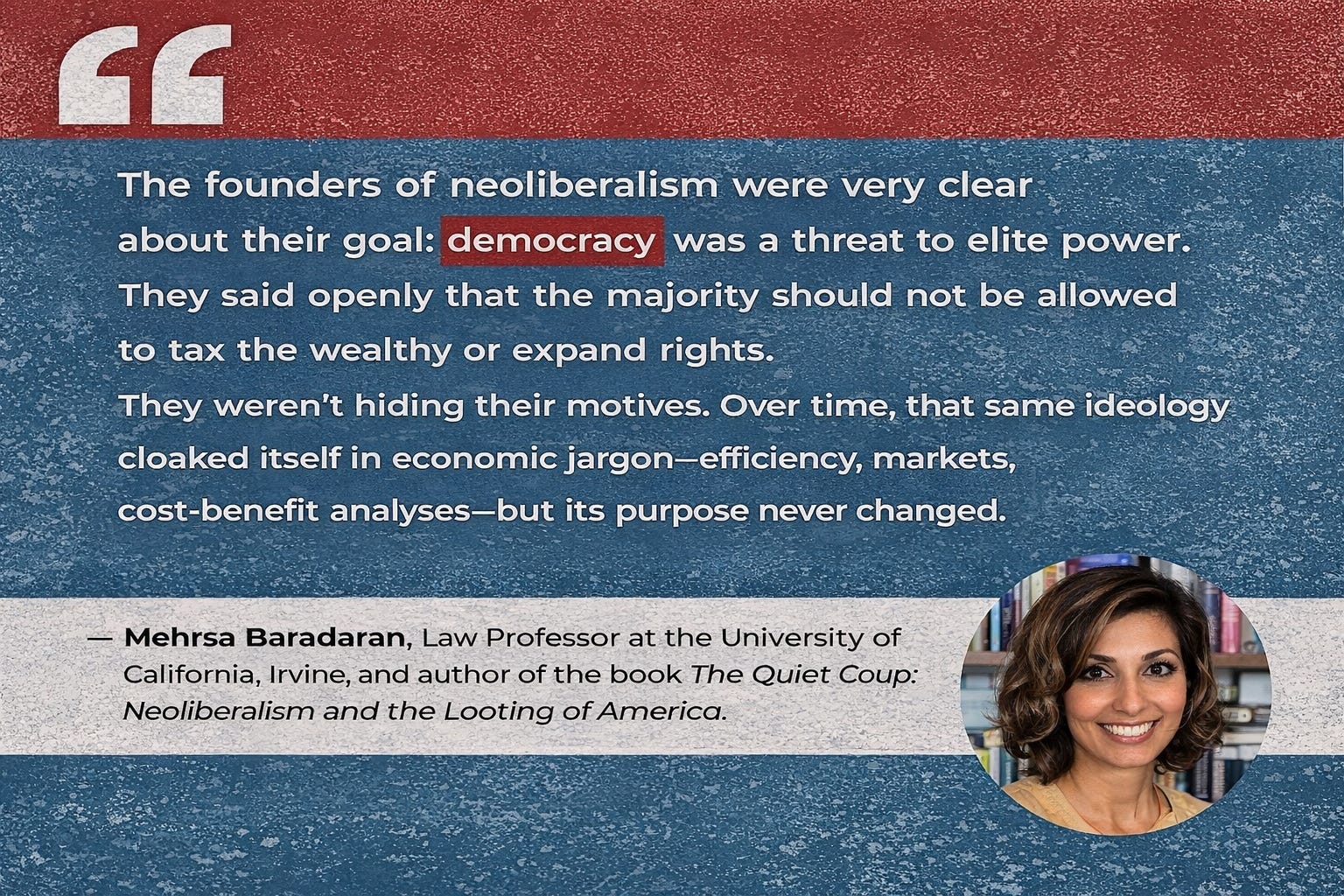
The collapse of political trust does not arise spontaneously, nor can it be explained by bad leadership, cultural decline, or voter irrationality. It has a clear intellectual and institutional origin. That origin lies in the neoliberal redefinition of what governments owe their citizens and, just as importantly, what they no longer consider themselves responsible for providing.
What begins in the late twentieth century under leaders such as Margaret Thatcher and Ronald Reagan is often described as an economic shift. In practice, it is a moral and political one. Neoliberalism does not simply deregulate markets or privatise industries; it redefines obligation itself. The relationship between citizen and state is transformed from one grounded in mutual responsibility into one mediated by markets, contracts, and individual risk. The language of choice, efficiency, and personal responsibility steadily displaces the language of rights, protection, and collective provision.
Under this framework, collective responsibility gives way to individual success and failure. Social outcomes are recast as personal achievements or shortcomings rather than the result of structural conditions. Greed is reframed as efficiency. Accumulation becomes virtue. Inequality is no longer treated as a political problem requiring correction, but as evidence of merit or competitiveness. Structural imbalance is naturalised, and its consequences are removed from democratic debate. Poverty becomes a failure of effort. Precarity becomes flexibility. Security becomes something to be earned rather than guaranteed.
Politics, under neoliberal logic, ceases to function as a mechanism for social protection and increasingly operates as a facilitator of markets. The role of the state shifts from steward to broker. Rather than balancing power or reducing harm, governments are tasked with clearing obstacles for capital, maintaining investor confidence, and ensuring the smooth operation of markets treated as external forces rather than political constructions. Economic arrangements are presented as neutral realities rather than choices shaped by policy.
Public goods are reframed as inefficiencies. Welfare becomes dependency. Regulation becomes interference. Labour protections are described as rigid. Environmental safeguards are cast as burdens on growth. Democracy itself is quietly reimagined as a risk to stability when it produces outcomes that unsettle markets or constrain capital mobility. Political legitimacy becomes conditional, acceptable only so long as it does not disrupt profitability.
Importantly, this transformation is seldom portrayed as an ideological decision. Instead, it is presented as essential. Governments argue that there are no alternatives, citing global competition as requiring flexibility and markets as constraining political choices. Political actions are reframed as technical responses rather than judgments. Responsibility shifts from elected officials to abstractions like “the markets,” “globalisation,” or “investor confidence.” When negative consequences occur, they are seen as unfortunate but inevitable. Authority remains with policymakers, while accountability is deflected.
One of the clearest expressions of this logic is the privatisation of publicly owned enterprises. Infrastructure built through collective effort over generations, including water, energy, transport, and telecommunications, is reframed as dormant capital awaiting activation. Governments sell these assets at discounted prices, often to private buyers with political connections, justifying the transfer on the grounds of efficiency or fiscal prudence.
Public services follow the same trajectory. Health, housing, education, transport, and care are increasingly treated not as obligations of citizenship, but as markets. Service quality becomes subordinate to shareholder return. Access becomes conditional on the ability to pay. Accountability fragments as private operators answer to contracts rather than citizens, while governments deflect responsibility by pointing to providers they no longer directly control.
The most corrosive feature of this model emerges when privatisation fails, which it frequently does. When private operators collapse or withdraw, the public is forced to step back in, not as owner but as insurer of last resort. Governments absorb losses, whereas private actors retain profits earned during successful periods. Risk is socialised. Profit remains private. This is not a flaw in the system. It is the system operating as designed.
Eventually, the pattern emerges: assets funded by public money are transferred at a discount to private owners. Prices rise. Service quality declines. Accountability disappears. Trust erodes because dispossession is experienced directly rather than abstractly.
The result is a politics without obligation. Governments retain power but relinquish responsibility. They continue to govern, tax, police, and regulate behaviour, but no longer accept responsibility for outcomes that undermine security, stability, or dignity. When citizens recognise this withdrawal, mistrust follows not as emotion, but as a conclusion.
The soil in which contemporary political mistrust develops is not due to a rejection of democracy itself, but rather to its redefinition to accommodate dispossession while maintaining the illusion of choice. Digital media ecosystems amplify this condition, but they do not cause it. They accelerate structural dynamics already set in motion.
Political mistrust is not new. What has changed is its function. Suspicion once acted as democratic pressure; it signalled that truth still mattered and that exposure could produce consequences. Under Trump, that relationship inverts. Distrust no longer exerts pressure; it stabilises it. Cynicism becomes normalised, and once normalised, it removes the expectation that leaders must be truthful.
III. Trump and the End of Truth as a Governing Constraint
“The Lie and the Liar”
Donald Trump exposes the fundamental logic of modern politics. Instead of inserting dishonesty, he eliminates the need to hide, justify, or reconcile lies with reality. This represents a clear shift: truth no longer constrains power.
Trump lies openly about the outcomes of his policies while the lived reality for many Americans deteriorates. He repeatedly claims prosperity and strength as households experience rising costs, insecure work, stagnant wages, worsening housing stress, and visible homelessness. He insists on success while social infrastructure deteriorates and public services are reduced. The contradiction is constant, material, and unavoidable.
What distinguishes Trump is not that he lies. Politicians have always lied. What distinguishes him is that his falsehoods are persistent, demonstrably untrue, and repeatedly asserted after correction, without political cost. Exposure does not lead to accountability. Evidence does not compel revision. Contradiction does not destabilise authority. His political survival demonstrates that truth is no longer required for governance. It becomes optional and disposable.
Political deception is not new. Leaders have long concealed failures, distorted evidence, or misled the public. What is new is the normalisation of demonstrable falsehood without reputational consequence: earlier systems required at least the appearance of alignment with fact. Exposure imposed a cost. In the current condition, open contradiction carries little penalty as long as loyalty holds. Persistence replaces credibility as the measure of power.
The pattern is most evident in his assertions concerning the 2020 United States presidential election. Trump persistently claimed that the election was “stolen” through extensive fraud, despite the lack of credible evidence, repeated judicial defeats, confirmations by state officials, and the rejection of these claims by his own Department of Justice. This assertion was not an isolated falsehood but a continuous narrative, reiterated long after it had been disproven. Its intent was not accuracy but framing. He aims to delegitimise outcomes that do not align with his interests and to replace institutional authority with personal authority.
The same logic governs his approach to climate change. Trump has repeatedly described climate change as a hoax or exaggeration, even as federal agencies, insurers, agricultural sectors, and international bodies documented escalating damage from fires, floods, heatwaves, and extreme weather. The denial persists not because evidence is unclear, but because it aligns with donor interests, deregulation agendas, and nationalist rhetoric. Observable reality is overridden by assertion, and contradiction produces no correction.
Trump’s claims about immigration and crime follow the same pattern: repeated assertions contradicted by available data, used to justify emergency powers, border militarisation, and punitive enforcement. Accuracy is secondary to utility. What matters is the construction of threat and the positioning of Trump as the sole guarantor of order.
Lying with ease is fundamental to Trump’s leadership approach. His falsehoods are intentional, not mistakes or defences. Rather than clarification, correction is perceived as an attack. Expertise is viewed as elitist, and institutions that oppose it are characterised as corrupt or disloyal. In this setting, lying becomes a strategic advantage rather than a danger.
It marks a structural shift. In earlier political eras, falsehoods were treated as liabilities that had to be minimised, plausibly denied, or corrected when exposed. Under Trump, falsehoods are asserted repeatedly, even after being disproven, because persistence replaces coherence as the measure of power. The ability to remain in place matters more than the ability to be right.
Trump does not reject neoliberalism. He strips it of restraint. Where earlier leaders cloaked market discipline in technocratic language or moral justification, Trump openly brutalises the logic. Accumulation is celebrated without apology. Inequality becomes a badge of success. Exploitation is reframed as toughness. Public office becomes a brand platform, a loyalty test, and a vehicle for personal enrichment.
His dishonesty is therefore structural rather than episodic. Tax cuts flow upward. Deregulation benefits corporate donors. Environmental protections are dismantled. Social protections are framed as waste or fraud. Failure is blamed on enemies: hostile media, disloyal officials, and corrupt institutions. Governance becomes performance. Assertion replaces evidence. Loyalty replaces competence. Spectacle replaces coherence.
Trump’s global significance lies not in ideology but in demonstration. He proves that institutions can be challenged, courts compromised, science rejected, and norms broken without causing immediate collapse. Democratic systems still operate formally, elections are held, courts convene, and markets run. However, the effectiveness of these correctional mechanisms diminishes as the demonstration spreads.
Trump functions as a permission structure for political leaders elsewhere. He signals that one can abandon truth, dismantle constraints, reward wealth upward, and still survive electorally. Authoritarian leaders point to him. Nationalist governments learn from him. Even formally democratic leaders have come to recognise that consistency and honesty are no longer power prerequisites.
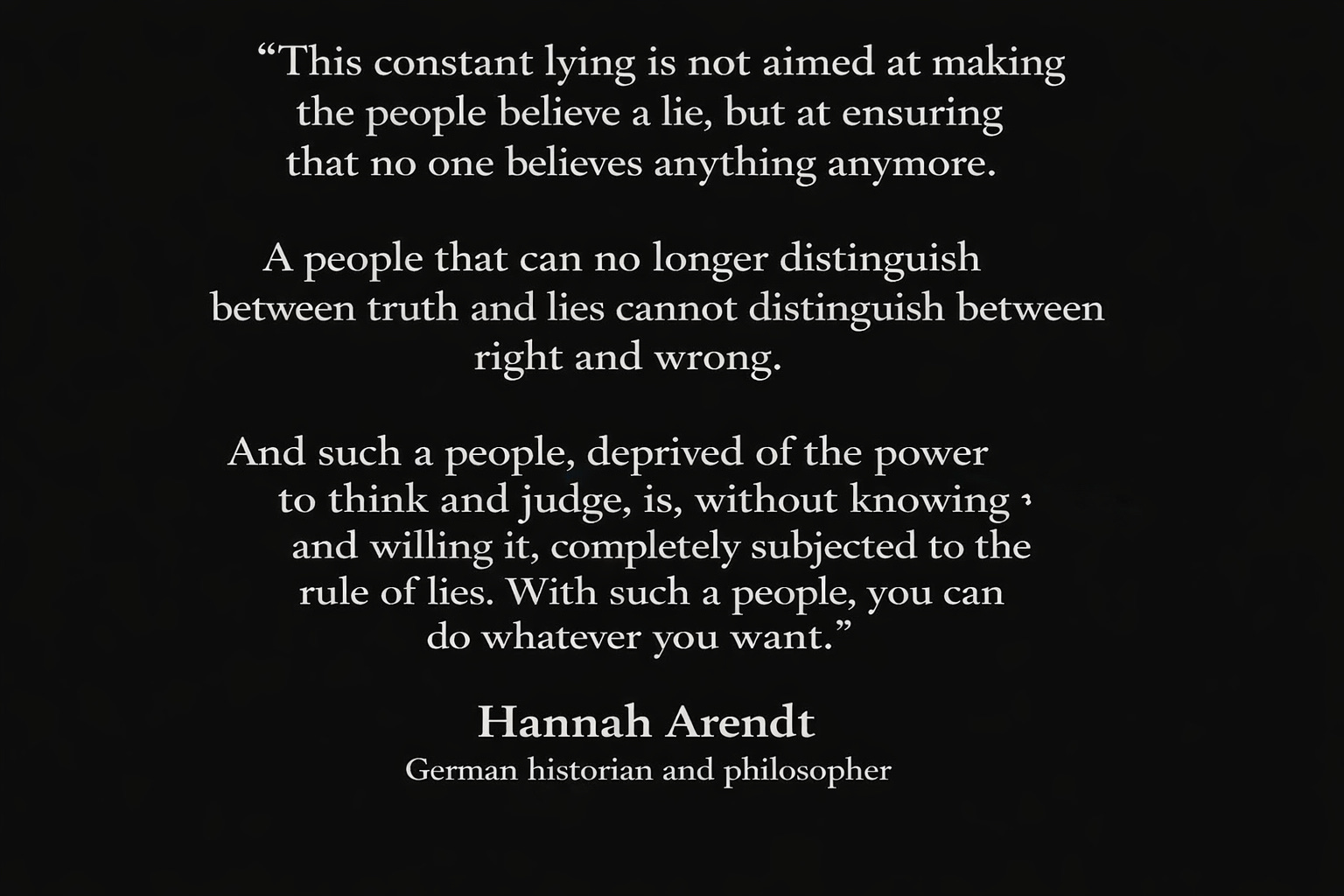
What Hannah Arendt warned about was not belief, but exhaustion. Trump’s politics does not seek mass conviction. It seeks saturation. Contradictions accumulate without resolution. Statements reverse themselves without consequence. The public is not persuaded. It is worn out.
In such an environment, people stop expecting coherence because incoherence carries no penalty. They disengage not because they are apathetic or uninformed, but because truth itself has been removed as a point of leverage. Power no longer needs to be right. It only needs to persist.
Trump matters not because he is unique, but because he exposes the outcome. He does not create the circumstances; he proves their viability. He reveals what politics becomes when duty is discarded and truth is ignored. In this way, he erodes public trust not only in America but worldwide, illustrating how democracy can be hollowed out without being overthrown.
IV. From Consent to Compliance
“The Surrender”
When trust collapses, governments do not abandon the political and economic model that produced it. They adapt to its consequences. That adaptation rarely takes the form of redistribution, repair, or renewed accountability. Instead, it takes the form of insulation and control. As legitimacy thins out, coercion quietly expands.
Consent depends on the belief that participation can influence outcomes and that power remains responsive to evidence, pressure, and lived reality. When that belief weakens, governments face a choice. Reform the structures that produce harm or manage the population that experiences it. Increasingly, they choose the latter.
Across various political systems, civil governance increasingly overlaps with security management. Policing becomes more prominent, militarised, and integrated into daily administration. Surveillance shifts from an occasional measure to a regular part of infrastructure. Claims of efficiency or safety justify data collection and the development of predictive risk models. They serve to offset waning trust by preventing dissent before it arises, rather than by addressing its root causes.
Social problems created by economic policy are reclassified as matters of order. Homelessness becomes a policing issue rather than a housing failure. Migration becomes a security threat rather than a humanitarian or economic question. Poverty is reframed as personal irresponsibility rather than structural exclusion. Protest is managed as a disruption rather than treated as a political expression.
The shift allows governments to maintain authority without restoring legitimacy. If consent weakens, compliance will suffice. The goal becomes not persuasion or inclusion, but containment. Public frustration is managed through enforcement and procedural complexity rather than addressed through structural change.
Elite insulation accelerates this transition. Political leaders operate within material conditions entirely different from those of the populations they govern. High salaries, pensions, legal immunities, expense privileges, and post-office employment through lobbying, consultancy, diplomacy, and corporate boards buffer them from the consequences of policy failure. Their personal security does not depend on the availability of functional public services, affordable housing, or stable employment. That insulation reshapes decision-making. Political risk is increasingly defined not by public harm, but by threats to stability, reputation, or market confidence. As long as disruption is contained and electoral procedures continue, serious social damage can be tolerated. Governance becomes risk management rather than stewardship.
The result is a profound transformation of democratic practice. Institutions remain in place. Elections continue. Legal processes operate. The relationship between power and population changes character. Citizens are no longer addressed primarily as participants, but as variables to be managed. Compliance replaces consent as the minimum requirement for an order.
That transformation rarely announces itself as repression. Expanded policing powers, tightened protest laws, surveillance technologies, and bureaucratic obstacles that fragment collective action. Each measure is justified individually. Together, they produce a political environment in which dissent becomes costly, visibility becomes risky, and disengagement becomes rational.
In practice, politicians mainly serve their Party rather than the general public. In Australia, this Party represents a very small segment of the population. While major parties are officially democratic, their active membership is usually only about 50,000 to 60,000 people out of over 26 million Australians. This small core preselects candidates, manages internal progress, enforces discipline, and determines political survival. For elected officials, allegiance to this tiny electorate has a more immediate impact than responding to the millions of voters who do not influence party decisions. It creates a structural imbalance within parliamentary democracy.
Policy positions are shaped less by broad public need than by factional power and internal bargaining. When politicians invoke “party unity” or “party discipline,” they are naming compliance with an internal hierarchy, not public consensus. Elections become moments of mass mobilisation around choices that party machinery has already narrowed in advance.
The danger is not an abrupt collapse of democracy. It is a quiet reconfiguration. Power remains. Institutions persist. Elections continue, but their corrective power thins as administrative control expands. Politics continues as ritual while its substance drains away.
Conclusion: The Verdict of Experience
“The Price”
What is commonly referred to as political apathy is, in fact, political recognition. People withdraw because they observe that participation no longer influences results. They notice that while the rhetoric of democracy persists, its core is steadily being stripped away.
Recognition is triggered not by ideology but through repeated encounters with contradictory messages. Citizens hear that economies are robust even as their personal lives become more unstable. They are told that security is improving, while public protections are diminishing, and enforcement efforts are increasing. Meanwhile, they are asked to accept sacrifices while elites remain shielded from the fallout. Eventually, it becomes clear that political claims no longer match reality, and exposure no longer prompts correction.
Neoliberalism supplied the framework for this rupture. It taught governments to sell what the public collectively owned, withdraw responsibility for social outcomes, and reframe the results as efficiency or inevitability. When this model produced inequality and insecurity, governments did not abandon it. They insulated themselves from its consequences.
Donald Trump accelerates this process by stripping away the final restraints. He demonstrates that truth itself can be discarded as a governing constraint without immediate collapse. In doing so, he signals globally that honesty, consistency, and obligation are no longer prerequisites for political survival.
This is where Arendt’s warning becomes urgent rather than historical. The danger is not mass fanaticism, but exhaustion. When contradictions accumulate without resolution and falsehoods carry no penalty, citizens stop engaging not because they believe lies, but because they no longer see truth as effective. Power no longer needs belief. It only needs endurance.
As trust collapses, coercion fills the gap. Policing hardens. Surveillance expands. Protest is managed. Social problems created by policy failure are reframed as matters of order rather than justice. Democratic life persists as ritual while its substance drains away.
This is institutional damage. Restoration requires structural repair.
Public mistrust is not a pathology to be cured or a communications problem to be managed. It is the verdict delivered by experience against a political order that has learned to govern without expecting to be believed. When power lies, democracy does not die loudly. It thins out quietly until compliance replaces consent and truth becomes optional.
Don’t stay silent.
If this analysis matters, share it. If independent work matters, support it.
Silence is how unaccountable power becomes normal.
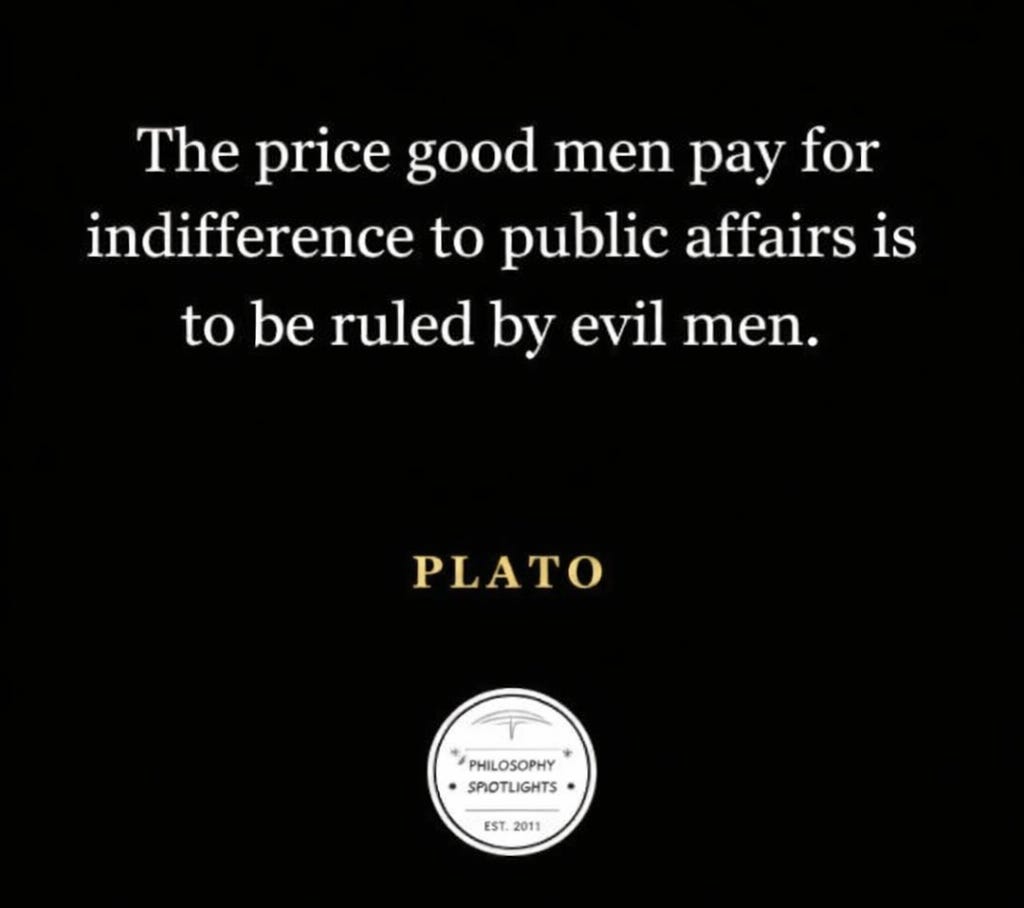
Refuse the comfort of indifference.
Subscribe for unfiltered analysis, it’s free. Restack to widen its reach.
Thank you, Randy. It does feel like a moment that tests public trust and civic responsibility. My aim was to encourage closer scrutiny of power and the narratives that surround it.
Good article. Certainly a time that tries men's souls with his cover-ups and deceit.